
Maybe you remember Patti’s wide bill, Chocolate’s antlers, or the way Legs could flop across your hand. Before there were hundreds of Beanie Babies to collect, there were nine little animals that started the collection.
The Original Nine are Brownie, later renamed Cubbie; Chocolate; Flash; Legs; Patti; Pinchers, also found with the early name Punchers; Splash; Spot; and Squealer. Ty traces their debut to 1993, with the early retail rollout continuing into 1994.
Several stayed in production for years, so a childhood favorite can belong to the original lineup even if your particular toy was made later. The details below will help you recognize each character and work out where your version fits.
Meet the Original Nine
Start with the animal, then check its tags. Each name leads to its character page in the vault.
| Character | What to look for |
|---|---|
| Brownie / Cubbie the bear | A brown bear with a dark nose. Brownie and early Cubbie share the same design; the name on the paper tag is the distinguishing detail. |
| Chocolate the moose | A brown moose with broad antlers. Chocolate continued through several tag generations, so the antlers identify the character while the tags help identify the release. |
| Flash the dolphin | A gray dolphin with a long snout and dorsal fin. Check the tags to distinguish early examples from later production. |
| Legs the frog | A green frog with long, floppy back legs. Legs was produced with first through fourth generation swing tags. |
| Patti the platypus | A platypus with a broad bill and flat tail. Color matters here: deep fuchsia, raspberry, and later fuchsia have separate release records. |
| Pinchers the lobster | A red lobster with two large claws. Some early tags read Punchers; the lobster itself cannot settle which name it originally carried. |
| Splash the whale | A black-and-white whale. Splash and the gray dolphin Flash are two different members of the nine. |
| Spot the dog | The early version has no spot on its back. A version with a back spot followed in 1994. |
| Squealer the pig | A pink pig with a rounded snout. Squealer appeared with first through fifth generation swing tags, so a familiar face alone does not date the toy. |
Start with the heart-shaped tag
The paper heart is called a swing tag or hang tag. Its design changed over time. Three early generations give you a useful starting point:
- First generation: thin “ty” lettering on a single heart that does not open. The character’s name and style number appear on the back.
- Second generation: thin lettering remains, but the tag opens like a little book, with a To/From section inside.
- Third generation: the lettering becomes wider and rounder. The tag still opens, and the front has no yellow star.
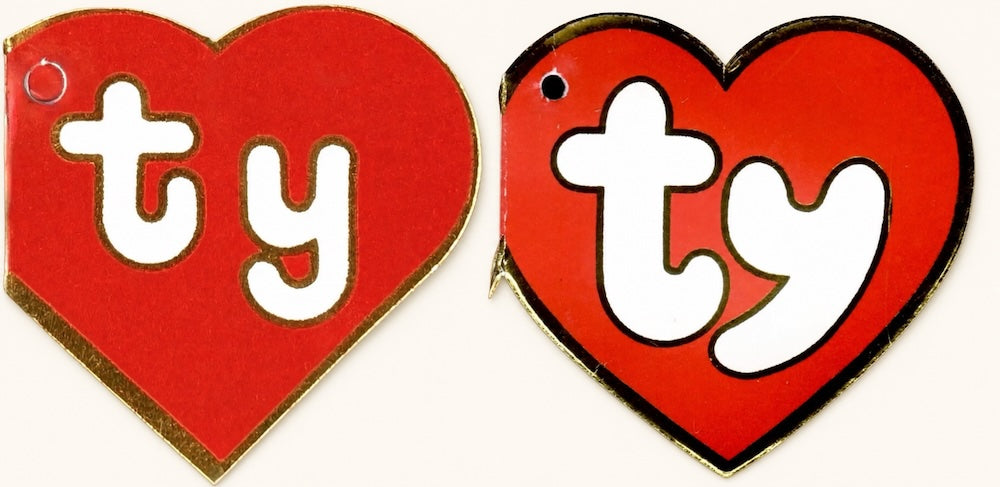
A third generation tag belongs to a later production period than a first generation tag, even when the character looks much the same. Fourth and fifth generation tags turn up on several of these animals too. Use our tag identification guide for full front, back, and inside comparisons.
Next, examine the tush tag, the fabric label sewn into the toy. First generation examples have black printing on white fabric, without the later red heart. Compare both tags with the record for the specific character and variation. A tag’s appearance is a clue, not proof of authenticity, and a printed copyright year does not by itself establish when your toy was made.
Four details worth a closer look
Brownie and Cubbie: keep the name with the bear
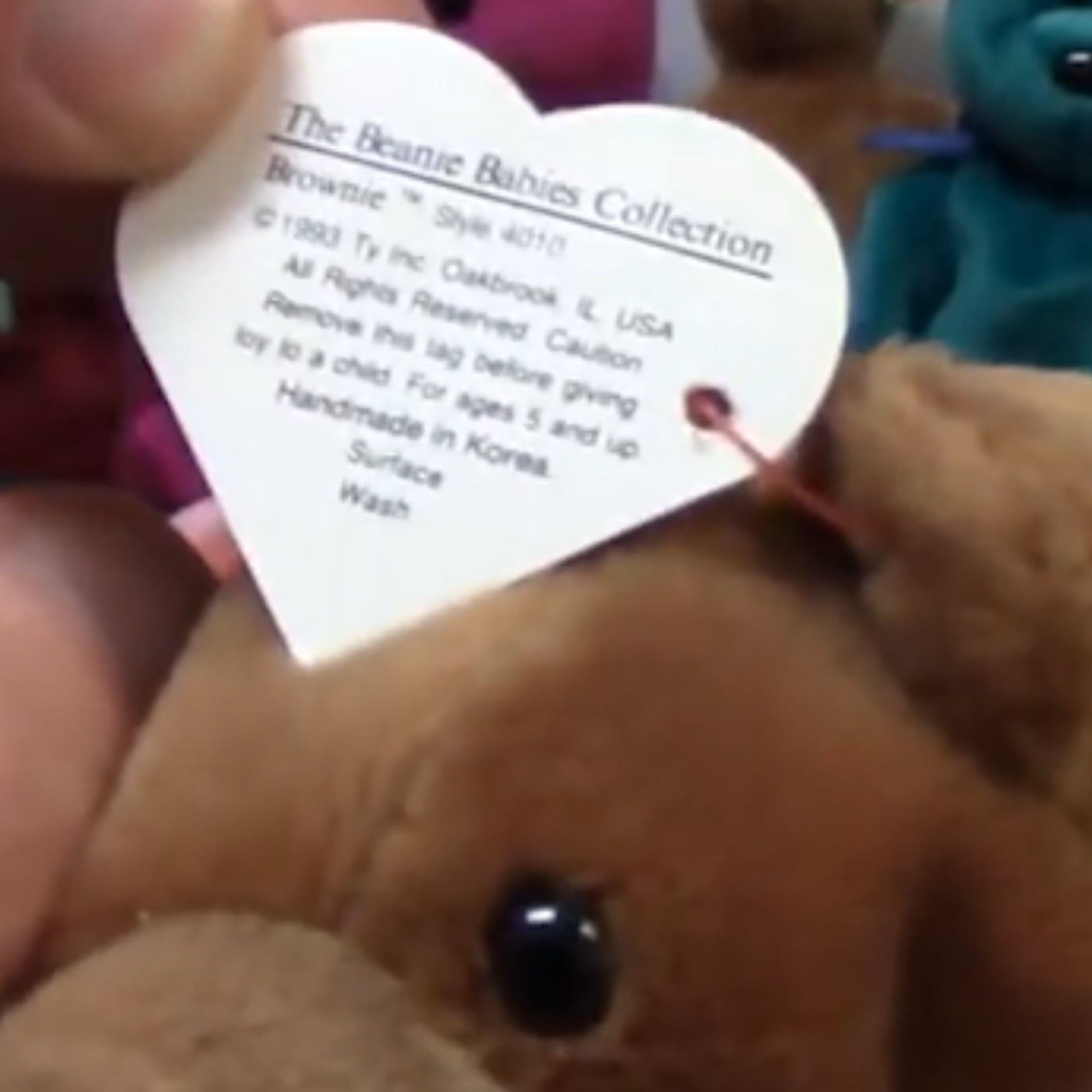
Brownie was the bear’s earlier name. Ty Collector records Brownie in 1993 and Cubbie from January 1994, and explains that the first generation bears cannot be distinguished without the swing-tag name.
If the paper tag is missing, the bear’s color and shape cannot establish that it was sold as Brownie. If it is attached, photograph the back clearly enough to read the name. That little line of print carries more useful information than a description such as “very old brown bear.”
Punchers and Pinchers: another name hidden in the tag
The early lobster can also appear with the name Punchers. Ty Collector records Punchers with first generation Korean swing and tush tags, and identifies the swing-tag name as the way to distinguish it from first generation Pinchers.
Check the spelling on the actual tag rather than relying on a seller’s title. With the paper tag gone, the lobster’s body cannot tell you whether it originally carried the name Punchers.
Spot: turn the dog over
For a dog named Spot, the earliest version has a memorable feature: no spot on its back. Ty Collector lists that version with first or second generation swing tags and a first generation tush tag. The version with a spot arrived in April 1994.
A clear photograph of the back is therefore useful. But the missing spot is only the first check, because Ty also revisited the design in its later Original Nine commemorative collection. Read the tags before calling a spotless dog an early release.
Patti: the shade needs a second check
Patti deserves more than a quick “pink platypus” identification. Ty Collector records deep fuchsia Patti in 1993 with a first generation swing tag, raspberry Patti in 1994 with first or second generation tags, and fuchsia Patti from 1996 with third through fifth generation tags.
Those names can be difficult to apply from one photograph. Lighting, camera settings, and fading can change how the fabric looks. Compare your Patti with the reference photographs for the named variation, then check whether its tags fit that record. Avoid assigning a color variant from a seller’s label or a single bright phone photo.
Could yours be a later Original Nine replica?
In 2005, Ty offered Original Nine replicas through the Beanie Baby Official Club, usually shortened to BBOC. The collection revisited familiar designs and names, including Brownie and Punchers. These are separate Ty releases with their own collecting history.
The replicas use special Original Nine swing tags and thirteenth generation tush tags. If your toy has a commemorative tag, compare it with a BBOC record before applying the early-generation checklist. The words “Original Nine” on a tag do not establish a 1993 or 1994 production date.
Make a useful record of your Beanie
Before putting a name or date to your find, gather these five views:
- The full toy from the front and back.
- The front and back of the paper heart.
- The inside of the heart, if it opens.
- Both sides of the sewn-in fabric tag.
- A close-up of any distinguishing detail, such as Spot’s back or Patti’s fabric color.
Write down what you can actually see: character, tag name, swing-tag generation, tush-tag details, and condition. Leave uncertain details open. For a toy without its paper heart, our guide to identifying Beanie Babies without hang tags explains what you can still learn.
Keep exploring the vault
Once you have a likely match, the character pages above are the place to explore its release history and related versions. You may discover an early variation, or simply put a name to the friend you remember.
If you want to research value, first narrow the comparison to the same version and tag generation, with similar condition. Our guide to using sold listings walks through that next step. For an uncertain early example, also see how to spot a fake Beanie Baby.
Sources and reference photographs
Historical overview: Ty’s Beanie Babies history. Version details: Ty Collector’s records for Brownie, Cubbie, Punchers, Spot without a spot, Spot with a spot, deep fuchsia Patti, raspberry Patti, fuchsia Patti, and the BBOC collection. See also its swing-tag reference.