
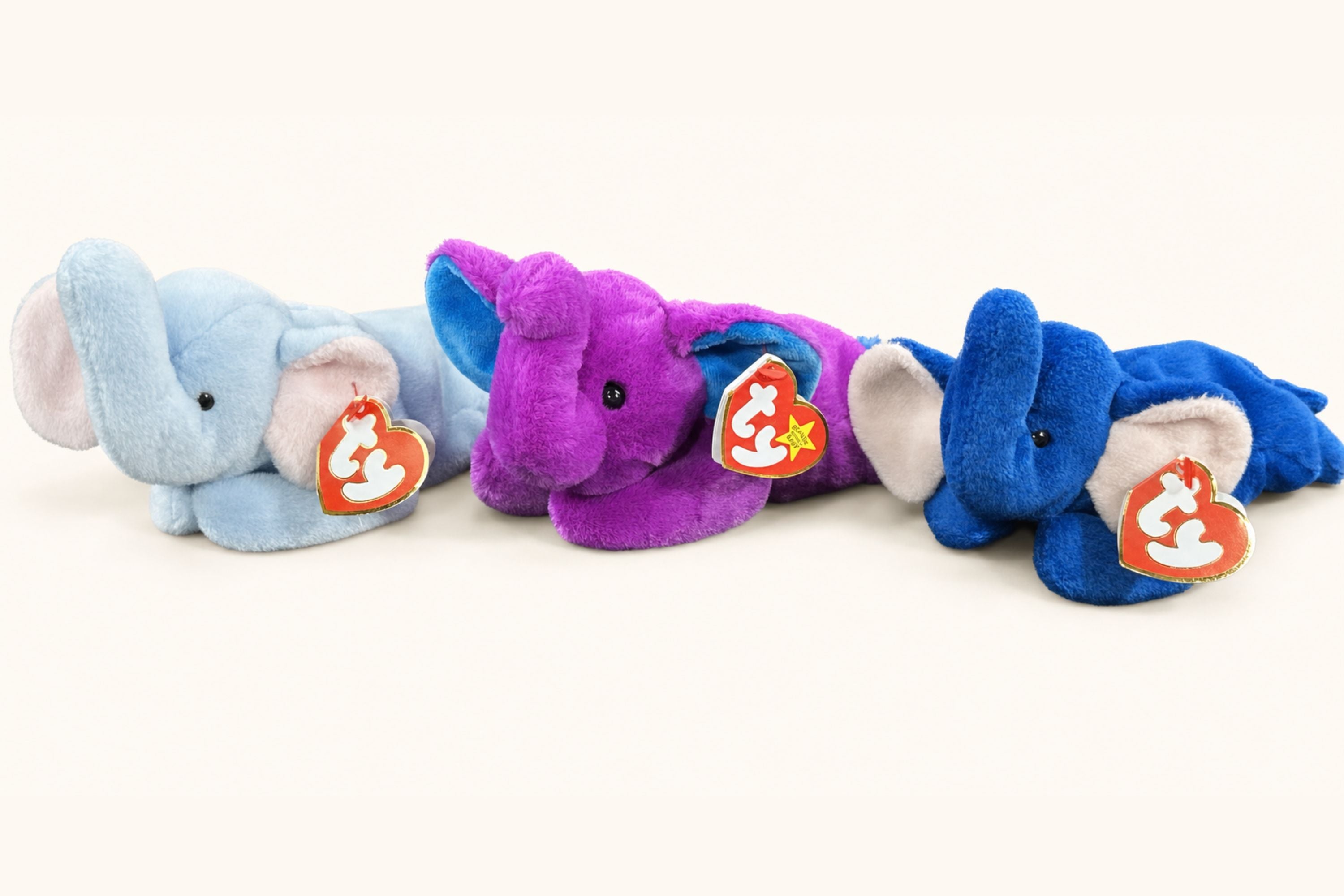
Peanut’s large ears and curved trunk are familiar across several Ty collections. The original Beanie Baby came in royal blue and light blue, and later toys revisited the elephant in different sizes. To identify yours, compare its product family, tags and color together.
Which Peanut do you have?
- Beanie Baby Peanut is the original small elephant, style 4062. Royal blue came first, introduced June 3, 1995 and retired October 2, 1995 with 3rd generation swing tags only. Light blue replaced it on October 1, 1995 and ran to May 1998.
- Beanie Buddy Peanut is the large version, style 9300, one of the original nine Beanie Buddies introduced September 30, 1998. It was made in royal blue and light blue with the same style number.
- Teenie Peanut is the miniature promotional release. Royal blue Peanut appears in the 2000 U.S. McDonald’s Legends group.
The comparison below separates those releases, including the later purple Peanut II. A photograph with a ruler is useful when the toy’s size is hard to judge.
Comparison table
| Version | Format | Style | Size | Key dates | Our record |
|---|---|---|---|---|---|
| Peanut, royal blue | Beanie Baby | 4062 | Classic Beanie scale | June to October 1995 | Royal blue Peanut |
| Peanut, light blue | Beanie Baby | 4062 | Classic Beanie scale | October 1995 to May 1998 | Light blue Peanut |
| Peanut, royal blue | Beanie Buddy | 9300 | 17 inches | September 1998 to February 2000 | |
| Peanut, light blue | Beanie Buddy | 9300 | 18 inches | September 1998 to February 2000 | |
| Peanut, royal blue | McDonald's Teenie | 2000 US promotion | Teenie scale | Summer 2000, Legends category | Teenie royal blue Peanut |
| Peanut II, purple | Beanie Baby, 30th Anniversary | 41308 | 9.25 inches | June 2023, trade show exclusive | Peanut II |
Royal blue and light blue
Royal blue was the first Beanie Baby version. Ty Collector records a short 1995 production period before the light blue version followed. That early color change is why the two blue Beanie Babies have separate reference records.
The colors also appear on the larger Beanie Buddies. Check the family name on the tags before comparing a royal blue toy with sales of the 1995 Beanie Baby.
Four details to record
- Product family. Look for Beanie Baby, Beanie Buddy or the McDonald’s promotional identity on the tags and packaging.
- Size. Measure the toy in the same position as the reference. Size helps separate the much larger Buddy from the smaller releases, but should be checked alongside the tags.
- Tags. The original royal blue Beanie Baby is documented with a third generation swing tag and first generation tush tag. If the tags differ, check whether you have another release or a replaced tag. Our tag identification guide explains the generations.
- Color. Compare fabric in even daylight. Lighting and fading can change the appearance of a blue toy in photographs.
What the Buddy tag is describing
The Buddy tag refers to the rarity of the earlier royal blue Beanie Baby. That text describes the smaller 1995 release, rather than assigning a value to the Buddy carrying the tag. Read the product-family label as well as the story inside the heart.
The purple one: Peanut II
Peanut II is the purple 2023 anniversary release. It has its own style number and modern tags, so it belongs in a separate comparison from the original blue Beanie Babies. Follow the Peanut II record for its release details.
If you are checking authenticity
Counterfeits of the original blue Beanie Babies are documented. Compare the fabric, trunk, ears and tags with references for the same version. Differences in size or texture deserve a closer look, but a general checklist cannot authenticate an individual toy. See how to spot a fake Beanie Baby for a careful screening method.
Then check the market
The Market Tracker has separate pages for Peanut (royal blue) and Peanut (light blue). Match the family, tag generation and condition before treating a sale as comparable.
Continue exploring
- The royal blue Peanut in the character database
- Beanie Baby tag identification: swing and tush tags
- How to value a Beanie Baby using completed sales
- Teenie Beanie Babies versus Beanie Babies