
If you’re sorting through a collection of Beanie Babies, you don’t need to research every toy before deciding which ones deserve a closer look. Start with the tags, then check for a few specific versions that collectors seek out.
Most familiar, mass-produced Beanies have modest resale values. The ones worth setting aside often have an early tag, a documented design variation, or an early name that’s different from the one you remember. Here’s how to spot those clues without turning an afternoon of sorting into a research project.
Start with the heart-shaped hang tag
The paper heart, also called a swing tag, is one of the most useful things to check first. Its design changed over time, and the earliest versions can help you separate an early Beanie from a later toy with the same name.
For regular early U.S. Beanie Babies, look for these three designs:
| What you see | What it may indicate |
|---|---|
| Thin “ty” lettering on a single heart that does not open | A first-generation hang tag |
| Thin “ty” lettering on a heart that opens like a little book | A second-generation hang tag |
| Wider, rounder “ty” lettering on a folding heart, without a yellow star on the front | A third-generation hang tag |
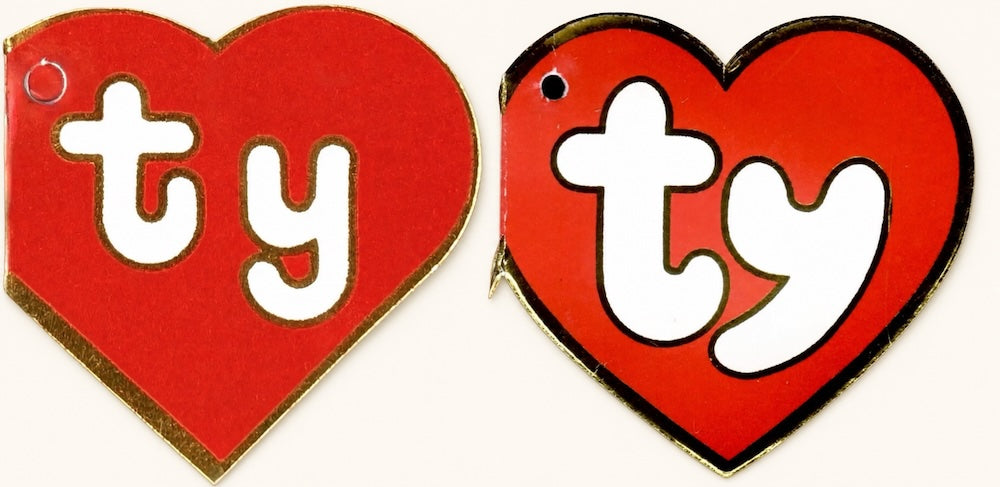
Thin lettering appears on both first- and second-generation tags. Check whether the heart opens to tell those designs apart.
If your tag resembles one of these, set the Beanie aside for a closer look. An early tag is a reason to investigate, not a price guarantee or proof of authenticity.
For sorting purposes, give first- and second-generation tags your attention first, followed by third-generation tags. These are the early releases that deserve an individual check before you put them into a bargain lot.
The familiar yellow star generally points to the later, mass-produced era. Most ordinary examples belong in the inexpensive pile, even when their tags are pristine. A tag protector means someone took care of the tag; it doesn’t make the Beanie scarce.
There are exceptions, so use the star as a shortcut rather than a final verdict. Our Beanie Baby tag identification guide has the fuller comparisons.
If the hang tag is missing, check the sewn-in label
The fabric tush tag can still give you a useful clue. First-generation tush tags have black printing on white fabric, without the later red heart. If yours resembles that design, compare it with the tag guide rather than dismissing the toy because its paper heart is gone.
For Beanies like Brownie and Punchers, the original hang tag is needed to confirm the name. You can’t tell from the toy’s appearance alone. Our guide to identifying Beanies without hang tags explains what you can still establish.
Look for a few specific early versions
The character’s name alone often isn’t enough. A Beanie that stayed in production for years can look much like an earlier, more desirable version. These are useful examples to recognize while sorting.
Peanut in royal blue
The original royal blue Peanut is worth a closer look. Its rich blue fabric is visibly different from the familiar light-blue elephant, but color alone isn’t enough to identify the original release. Check the size, tags, and version: a McDonald’s Teenie or another later Peanut release is a different collectible.
Use our Peanut version guide to compare the possibilities before assigning a value.
Spot without a spot on its back
Turn the dog around and look at its back. The early version of Spot has no back spot, which makes it a useful design clue you can check immediately.
Then check the tags. Later commemorative releases revisited early designs, so a spotless back by itself doesn’t establish that you have the early version. Our Original Nine guide explains that distinction.
A lobster whose tag says Punchers
Read the name on the actual hang tag. Some early lobster tags say Punchers, rather than the familiar Pinchers. That spelling is worth setting aside for a closer look.
The lobster’s body alone cannot tell you which name it originally carried. If the hang tag is missing, don’t assume it was Punchers. Later commemorative toys also used the early name, so the tag design matters alongside the spelling.
A bear whose tag says Brownie
Brownie was the early name of the bear later called Cubbie. As with Punchers, the name on the original hang tag is the important clue. A brown bear without that tag cannot be confidently identified as Brownie from its appearance alone.
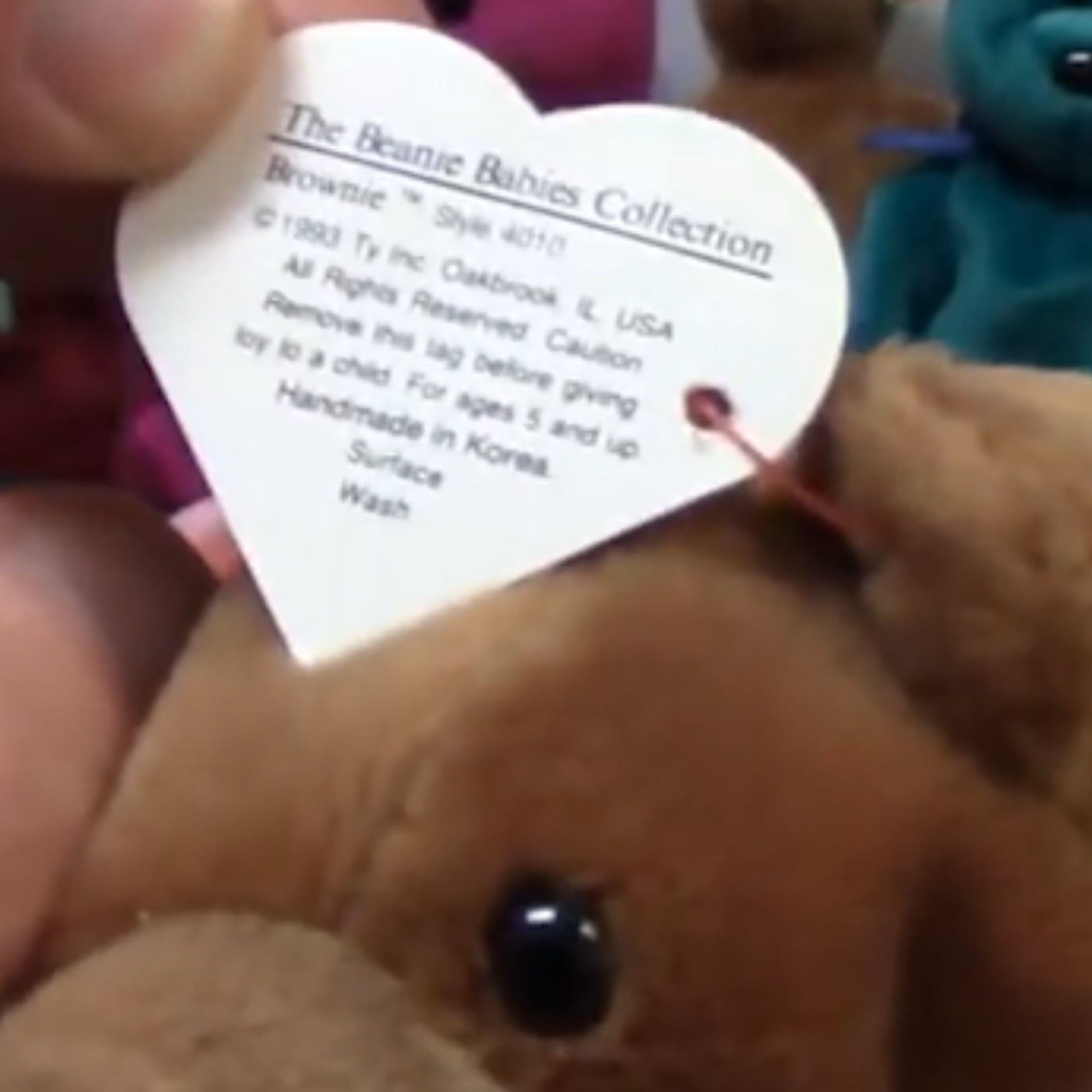
Look for the printed name, not just a familiar face. This early tag identifies the bear as Brownie.
These examples aren’t a complete list of desirable Beanies. They show the kind of specific difference that deserves attention: a particular tag, name, or documented design, rather than simply an old-looking toy.
A few more names to set aside
Early Steg, Rex, Bronty, and Trap are also worth checking individually. Match the tags as well as the character, especially when a later release looks familiar.
Among later Beanies, collector-recognized variations such as brown-bellied Sly or Lucky with 21 spots can warrant another look. Employee-exclusive bears are another category to separate. These are specific leads to check, not a reason to treat every production difference as a valuable error.
Separate the McDonald’s toys from the full-size Beanies
Before you compare prices, make sure you’re comparing the same product line. A small McDonald’s Teenie Beanie is not the full-size Beanie Baby, even when the name and animal match. Beanie Buddies and Attic Treasures are separate Ty lines too.
For Teenies, expect roughly $1–$2 apiece in many ordinary selling situations. Original packaging is preferable, but it doesn’t make an individual toy rare. Well-priced lots are usually the more practical way to sell them, and complete original 1997 sets can bring a little more. Our Teenie Beanie Babies value guide covers those differences.
Don’t mistake a familiar date or label for a valuable version
A printed copyright year is not, by itself, the date your particular toy was manufactured. A birthday in the hang tag doesn’t establish that either. Likewise, being “retired” doesn’t automatically make a Beanie scarce.
The same applies to belonging to the Original Nine. That describes the original character lineup, but several of those characters remained in production through later tag generations. A later Chocolate or Squealer isn’t automatically an early example because the character debuted with the first group.
Common spelling issues, spacing differences, or PVC pellets alone also aren’t enough to establish a valuable Beanie. You don’t need to inspect every word for a supposed error before moving on. Our guide to Beanie Baby errors and value myths covers those claims in more detail.
Give the promising ones a condition check
Once you’ve found something worth investigating, look at the plush and tags separately. Check for stains, fading, odors, repairs, creases, and writing. Mint condition with mint tags is desirable, but perfect condition doesn’t turn a common release into a rare one.
Don’t discard an interesting early toy just because its tag is creased or missing. Condition affects its appeal, but the version still matters. Our MWMT and condition guide explains what to look for.
What to do if you find a promising Beanie
Keep its tags attached and take clear photos of the whole toy, both sides of the tush tag, and the front, back, and inside of the hang tag where applicable. Those details will help you confirm the version.
Once you know what you have, use our Beanie Baby Market Tracker as a starting point for recorded sales. Check whether the results describe the same version and tag generation; a general price for the character may combine examples that aren’t comparable to yours. If an early or potentially valuable example is difficult to verify, our guide to spotting fake Beanie Babies explains the next checks.
For a first pass through a collection, that’s enough: separate the early tags and identifiable variations, then investigate those. You can leave the detailed valuation work until you have a specific reason to do it.