
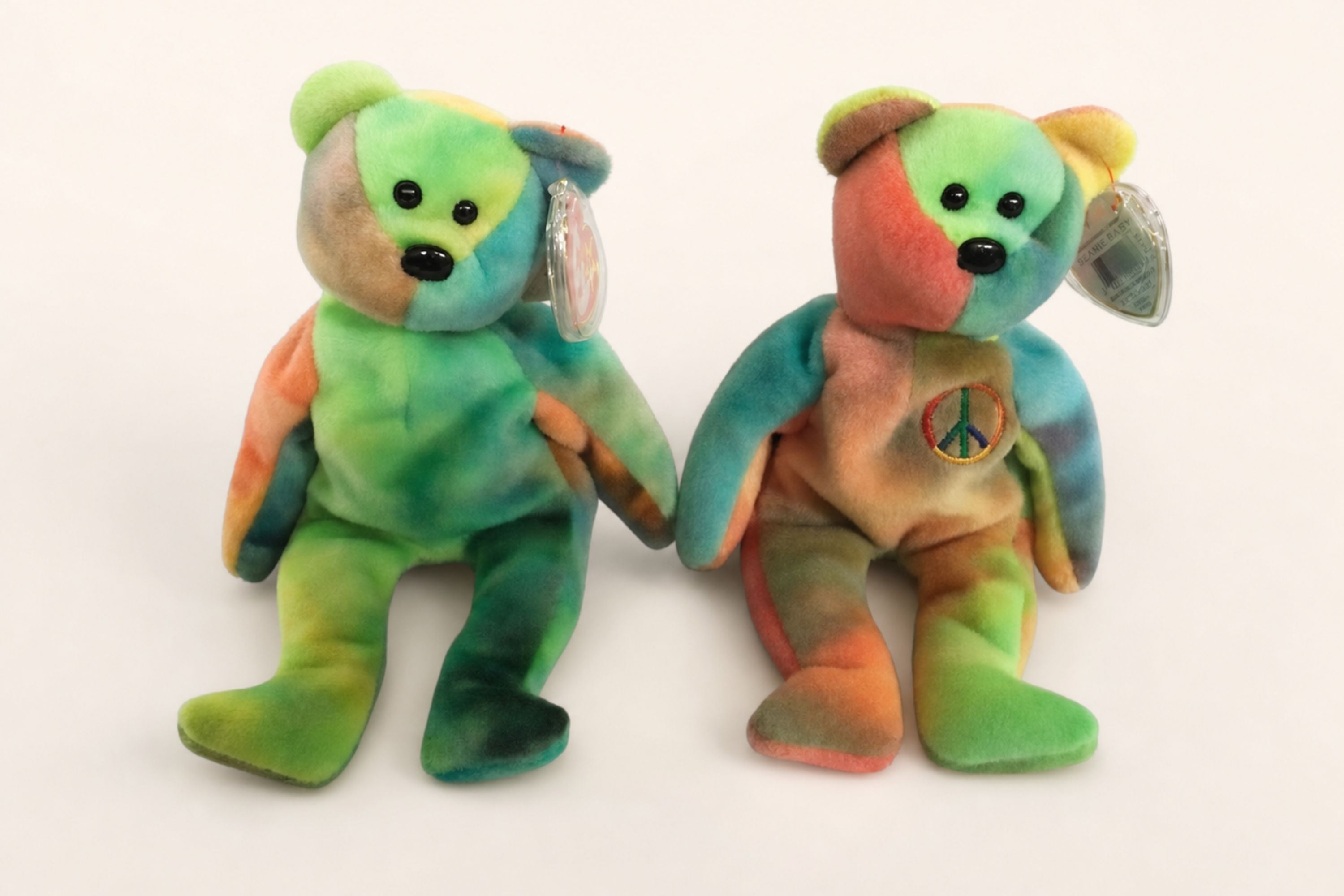
Peace and Garcia share a rounded bear design and tie-dyed fabric. The most visible difference is on the chest: Peace usually has an embroidered peace symbol, while Garcia has a plain chest. The tags help confirm the match.
Quick answer
Garcia came first, followed by Peace in May 1997. Their similar bodies make them useful to compare side by side. Begin with the chest, then read the names and compare the tags with the table below.
Gather three details:
- Does the chest carry the embroidered peace symbol?
- What name is on the swing tag and the tush tag?
- Do the tag generations match the version's production window?
What to look at first
1) Chest emblem
Check the chest in a clear front view, with the ribbon moved aside gently if necessary. A documented Peace oddity lacks the emblem, so a plain chest alone cannot establish that the bear is Garcia. The original tags become especially useful in that case.
2) Tag identity
Garcia is documented with third and fourth generation swing tags; Peace with fourth and fifth generation tags. Compare the sewn label too. A tag outside the documented range calls for further investigation, rather than an immediate conclusion about authenticity. Our tag identification guide provides photographs.
3) Fabric and the pastel family
The arrangement of colors varies from bear to bear. Peace also has a documented pastel tie-dyed version, associated with fifth generation swing tags and sixth generation tush tags. Compare the fabric in even light and use the tag combination to support the identification.
Comparison table
| Check | Garcia | Peace | Why it matters |
|---|---|---|---|
| Style number | 4051 | 04053 | Confirms which family you are in |
| Birthday | August 1, 1995 | February 1, 1996 | Printed inside later swing tags |
| Introduced | January 7, 1996 | May 11, 1997 | Peace launched the day Garcia retired |
| Retired | May 11, 1997 | July 14, 1999 | Keeps the timeline clean |
| Chest emblem | None | Embroidered peace symbol | The main visible difference |
| Swing tags | 3rd and 4th generation | 4th and 5th generation | Investigate a pairing outside the documented range |
| Tush tags | 2nd and 3rd generation | 3rd through 6th generation | Pastel Peace pairs 5th swing with 6th tush |
Variations worth recording
Peace is one of the most oddity-rich Beanie Babies documented. Known examples include Peace bears with Blackie, Curly, Garcia, Teddy, or Valentino tush tags, the no-emblem Peace, and 5th generation swing tags carrying the "ORIGIINAL" and "Suface" printing errors. Indonesia-made Peace bears also come with two different sizes of embroidered peace symbol, a documented variation rather than a defect.
An unusual detail can be interesting to document without establishing a price premium. For printing differences, errors and value myths explains which checks are useful.
Counterfeits of both bears are documented. Compare construction as well as color, and use the fake-spotting checklist when a feature needs closer examination.
Identification checklist
- Confirm the chest emblem first.
- Read the swing tag and tush tag together, never separately.
- Compare the style number and the intro and retirement dates.
- Check that the tag generations fit the claimed version's window.
- Photograph the fabric pattern in even light, allowing for normal variation in color placement.
- Keep the identity uncertain if the chest and tags do not provide a consistent match.
Comparing sale records
The Market Tracker includes Garcia the Bear and Peace the Bear. Compare individual sale records with the same version, tags and condition; a shared character name may cover more than one kind of example.
Continue exploring
- Garcia the Bear in the character database
- Peace the Bear in the character database
- Beanie Baby tag identification: swing and tush tags
- How to value a Beanie Baby using completed sales